In collaboration with the Sam Francis Foundation, we are pleased to look at the archival connections between Haywood Bill Rivers and Sam Francis.
Haywood Bill Rivers: Archive Connection
(1922–2001)
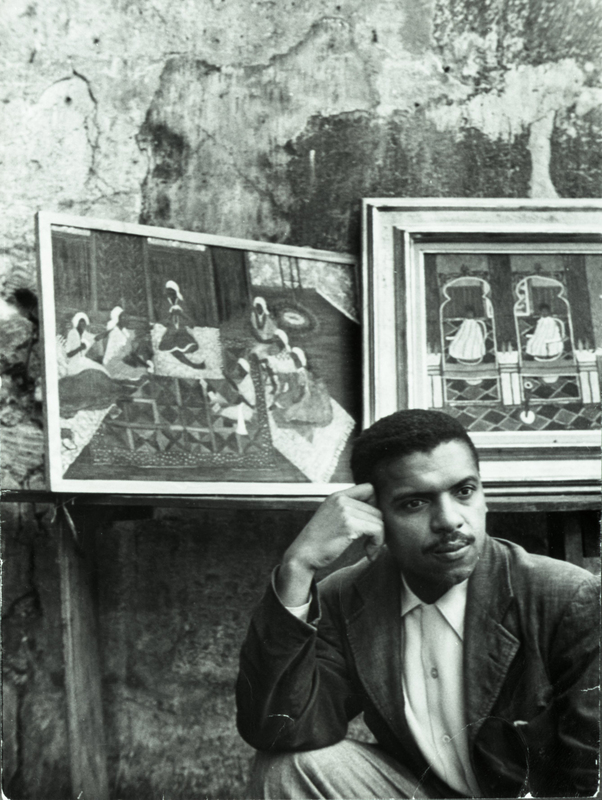
Haywood Bill Rivers in Paris, 1950. Photo by Lisa Larsen for LIFE magazine.
Haywood “Bill” Rivers was born May 8, 1922 in Morven, North Carolina.
Rivers received several awards in the very early years of his artistic career, the first was from the Maryland Institute in 1944. However, they did not honor their offer due to racism. With the assistance of the NAACP, Rivers did receive scholarship funds from the state of Maryland. He then moved to New York City where he attended the Art Students League. (Debas, p. 90)
In 1948, the Baltimore Museum of Art offered Rivers a solo exhibition. Just four short years after his leaving Maryland. Was he the first African American artist to have a solo exhibiition at this museum?
He was awarded a Rosenwald Fellowship in 1948 and the John Hay Whitney Fellowhip in 1952. With the Rosenwald award, Rivers planned to travel American southern states from Virginia to Florida. Not only is this award influential in the time and space this affords an artist, the direct connections to Paris also become clear. As Rosenwald’s grandson, Robert Rosenwald, was a sponsor and supporter of Galerie Huit in Paris.
Haywood Rivers set off to France in 1949. In Europe he would marry Betty Jo Robirds, a Fulbright scholar from Los Angeles, and they would start a family. They would also share a house with Sam Francis and Muriel Goodwin.
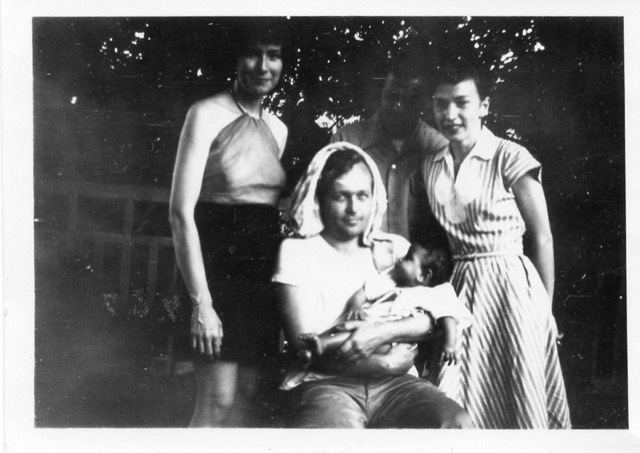
Betty Jo Rivers, Bill Rivers, Muriel Goodwin and Sam Francis (seated) with Cézanne Rivers.
Sam, Muriel, Bill and Betty shared the rent on a house at 21, Rue des Châtres-Sacs, Sèvres on the Southwestern outskirts of Paris.
“Francis and Muriel use the large ground-floor room, while the Rivers live on the first floor. The home is designed for summer living only, so they suffer a cold, damp winter without heat. Muriel later recalls: ‘We had mold growing in our shoes overnight.’” (Burchett-Lere, p. 156)
Not only was Francis a friend, he was godfather to the Rivers’ first child Cézanne.
Muriel Goodwin, also an artist, was a lifelong friend to Bill, his first wife Betty and their two children Cézanne and Maya. Letters between Muriel and the Rivers are housed in the Rivers papers at the Archives of American Art. They talk of artmaking, their lives as artists and their shared interest in the Dilexi Gallery in San Francisco. Rivers worked with Jim Newman at the gallery where Goodwin also exhibited.
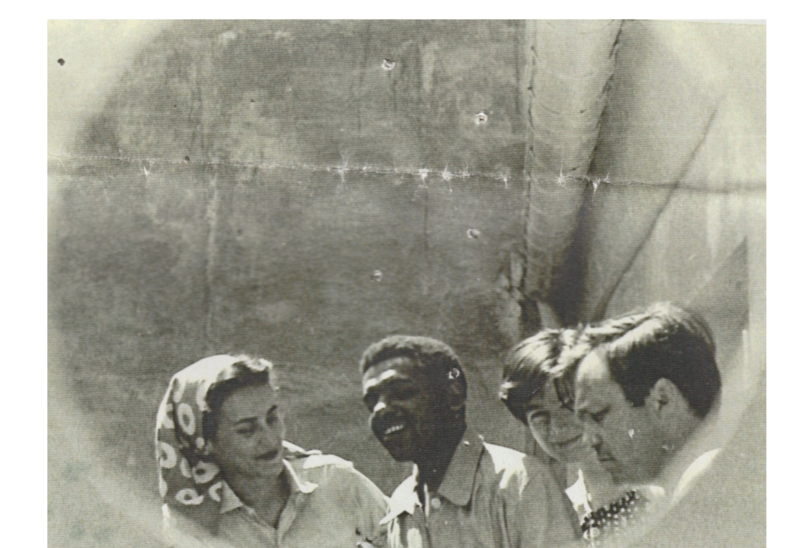
More shared time in France.
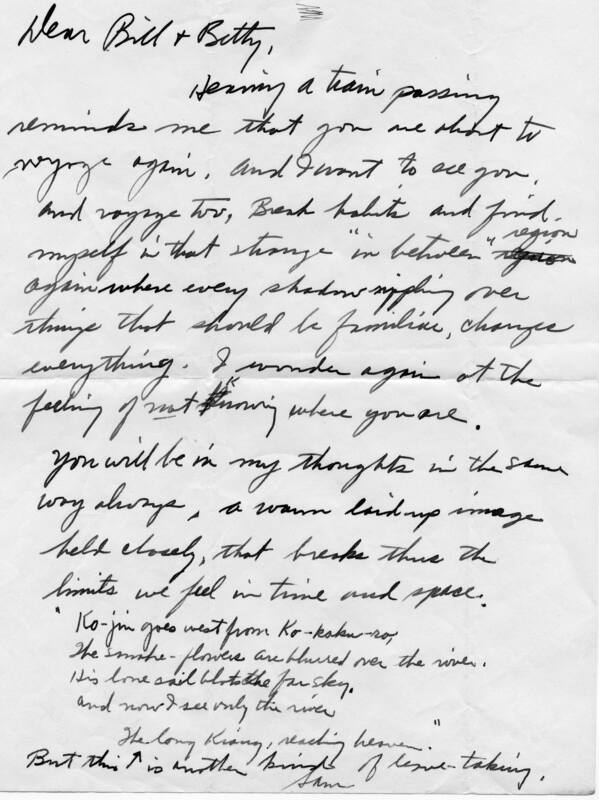
Letter from Sam Francis to Bill and Betty Rivers, ca. 1950s.
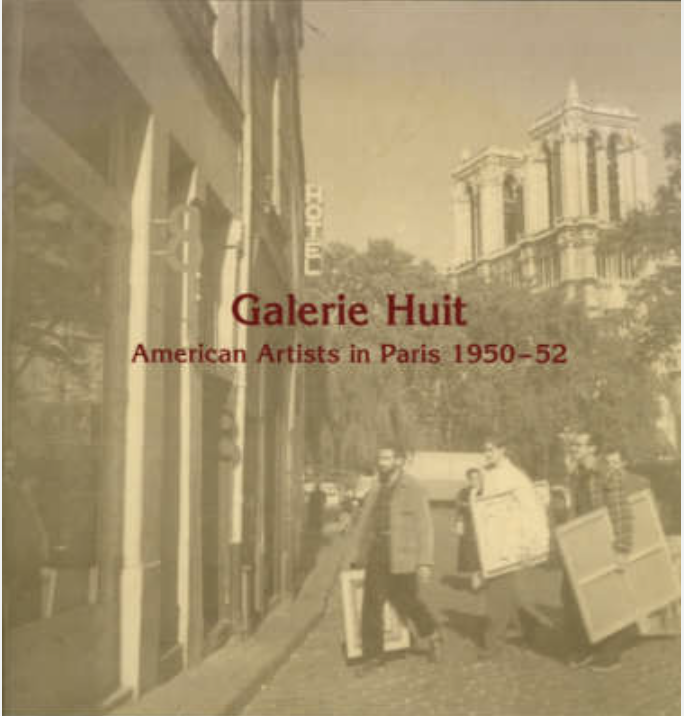
Cover image for catalog Studio 18 Gallery, New York “Galerie Huit: American Artists in Paris 1950-52” Nov 2 - Dec 28, 2002
Galerie Huit was a collective gallery formed by a group of artists in Paris in 1950. Haywood Rivers was voted by the collective to direct the gallery. Many say because of his capablity, kindness and ability to diffuse arguments. (Studio 18 Gallery, pp. 3-5)
“…located at 8, rue Saint Julien le Pauvre, across the river from Notre Dame cathedral. The former studio space of the sculptor Robert Rosenwald, the gallery primarily showcases young American artists, with exhibitions rotating every two weeks. Francis shows some works there, as do Muriel and Francis’s friends Simon Hantaï, Shirley Jaffe, Al Held, Jules Olitski, and others. Altogether, more than fifty artists will exhibit at Galerie Huit during its two-year existence, and it gains a reputation as an exciting place to see new work.” (Burchett-Lere, p. 156)
The connections between the group of artists in Paris is further illustrated at an exhibition and publication; “Americans in Paris” at NYU’s Grey Art Museum. The catalog is an in-depth look at a huge community of artists in Paris durung these years.
Rivers moved from France to New York to San Francisco and returned to Europe again. This movement and desire to live in multiple places was also something he and Sam Francis had in common.
Correspondence between Francis and Rivers has not yet been seen later than the 1950s. But in the Sam Francis Papers housed at the Getty Research Insitute a signed guest book from André Emmerich Gallery in New York from 1989, shows Haywood Rivers came to see Francis’s exhibit.
SELECT RESOURCES
Haywood Bill Rivers Papers - Archives of American Art
Sam Francis Papers - Getty Research Institute
Debas, Miles. “Haywood Bill Rivers.” In Hunter College Art Galleries, and Bertha and Karl Leubsdorf Art Gallery. 2018. Acts of Art and Rebuttal in 1971. New York: Hunter College Art Galleries. (exhibition catalog)
“Galerie Huit: American Artists in Paris 1950-52.” Studio 18 Gallery, New York, November 2 - December 8, 2002. (exhibition catalog)
Jones, Kellie. South of Pico: African American Artists in Los Angeles in the 1960s and 1970s. Duke Univeristy Press, 2017, p. 40
Major, Gerri. “Society World.” Jet, July 16, 1953, p. 42.
Raverty, Dennis. “Haywood “Bill” Rivers, L’Artiste Brut.” International Review of African American Art, 2006, 20 no. 4, pp. 29-35.
“The Search For Freedom: African American Abstract Painting 1945-1975.” Kenkeleba House, New York, May 19 - July 14, 1991. (exhibition catalog)
Schulman, Daniel. “African American Art and the Julius Rosenwald Fund,” A Force for Change: African American Art and the Julius Rosenwald Fund Northwestern University Press, 2009.